
Why does Apple hate its most loyal customers?
Billions seem to be at stake in "trade-in" fiasco

If you’ve ever traded-in a used car or boat for a new one, you’re intimately aware that the value of your “trade” reduced the purchase price of the new item in a key fashion — before the Harmonized Sales Tax was calculated on the vehicle. Buy an $80,000 Ford Bronco Outer Banks, and your $35,000 used car trade-in reduces the net purchase price to $45,000 for the purposes of calculating how much HST you remit to the Federal and Provincial governments. The new car dealer knows this full well, and there’s a chance that you’re getting shaved a bit on the value of your trade as compared to what you might get if you sold it on Kijiji, for example.
The $4,550 tax benefit (13% x $35,000) is significant, but the Taxman doesn’t actually lose out. When someone buys your used car from the dealership for $37,000 (or whatever), they’re going to pay the HST on the value of that transaction.
Not very complicated, and the same goes for every marina in Canada.
For reasons that are not clear, and no one at the flagship Toronto Eaton Centre store could explain why, Apple (AAPL:Q) does the math differently when you try to participate in that company’s “trade-in” program. Apple purports to offer a trade-in program when the time comes to upgrade your handset, but the truth is that they’re just buying the phone from you.
That head fake cost me an extra $82.55 the other day. Not worth a blog post, you might say, but for the elephant in the room: if Apple sells 4 or 5 million iPhones (plus iPads, Macs, etc.) a year across Canada, aren’t consumers unnecessarily paying hundreds of millions of dollars in additional tax each year?
Why don’t our elected officials — who are on the warpath to “make life more affordable” — fix this?
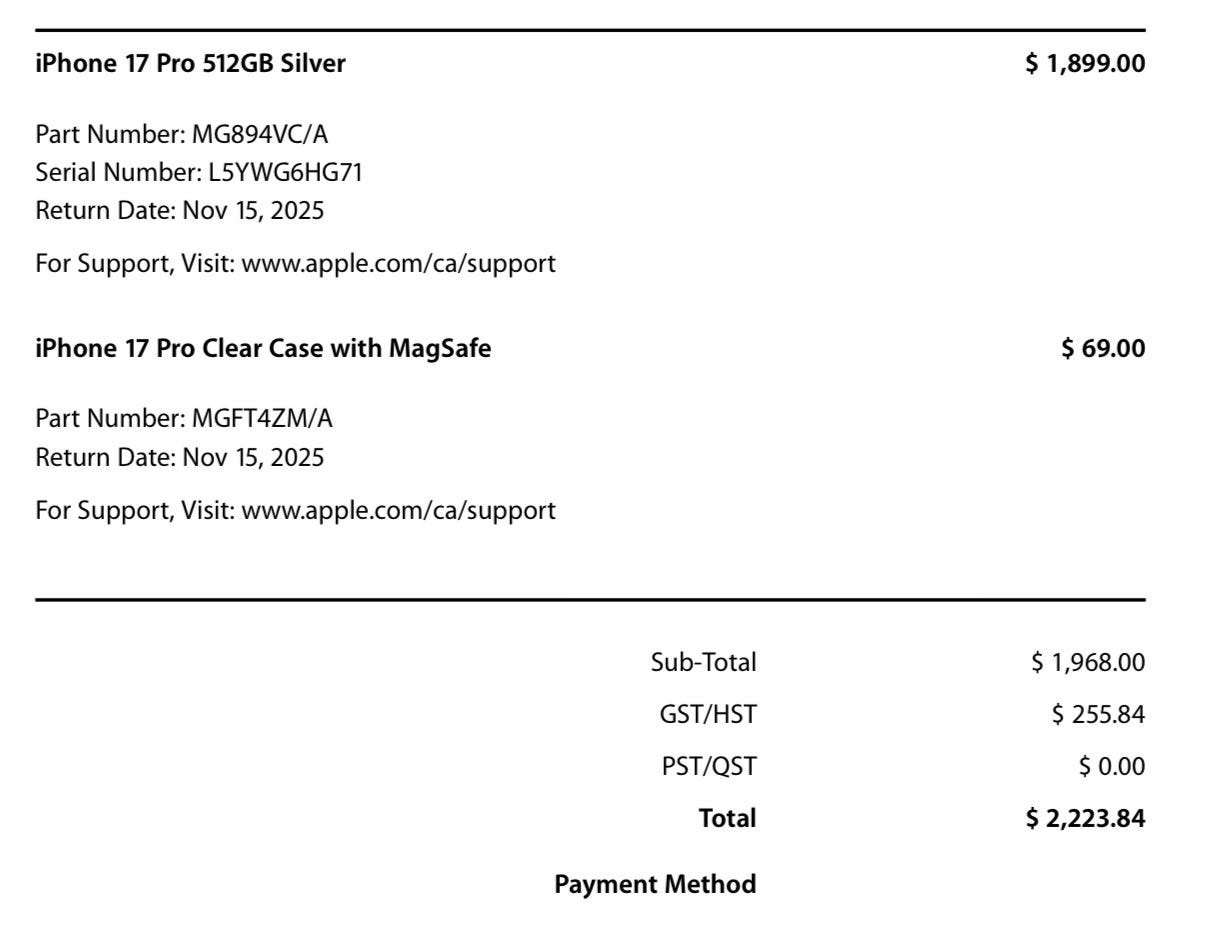
This is what our bill would look like if Apple applied your “trade-in” as Marco Mostarda at Toronto’s Downton Ford (and every other car/boat dealer in Canada) does:

Apple gave me $5 extra for “trading” my iPhone 15 Pro against the new model, instead of taking home a gift card for later use. (It’s worth noting that Apple’s recognized revenue from the sale was $1,968, not $1,333, a definite bonus to the company’s financial statements and valuation, ultimately.) As a shareholder, I get why the company would want to encourage a sale today, rather than put the $630 into deferred revenue, but that’s beside the point.
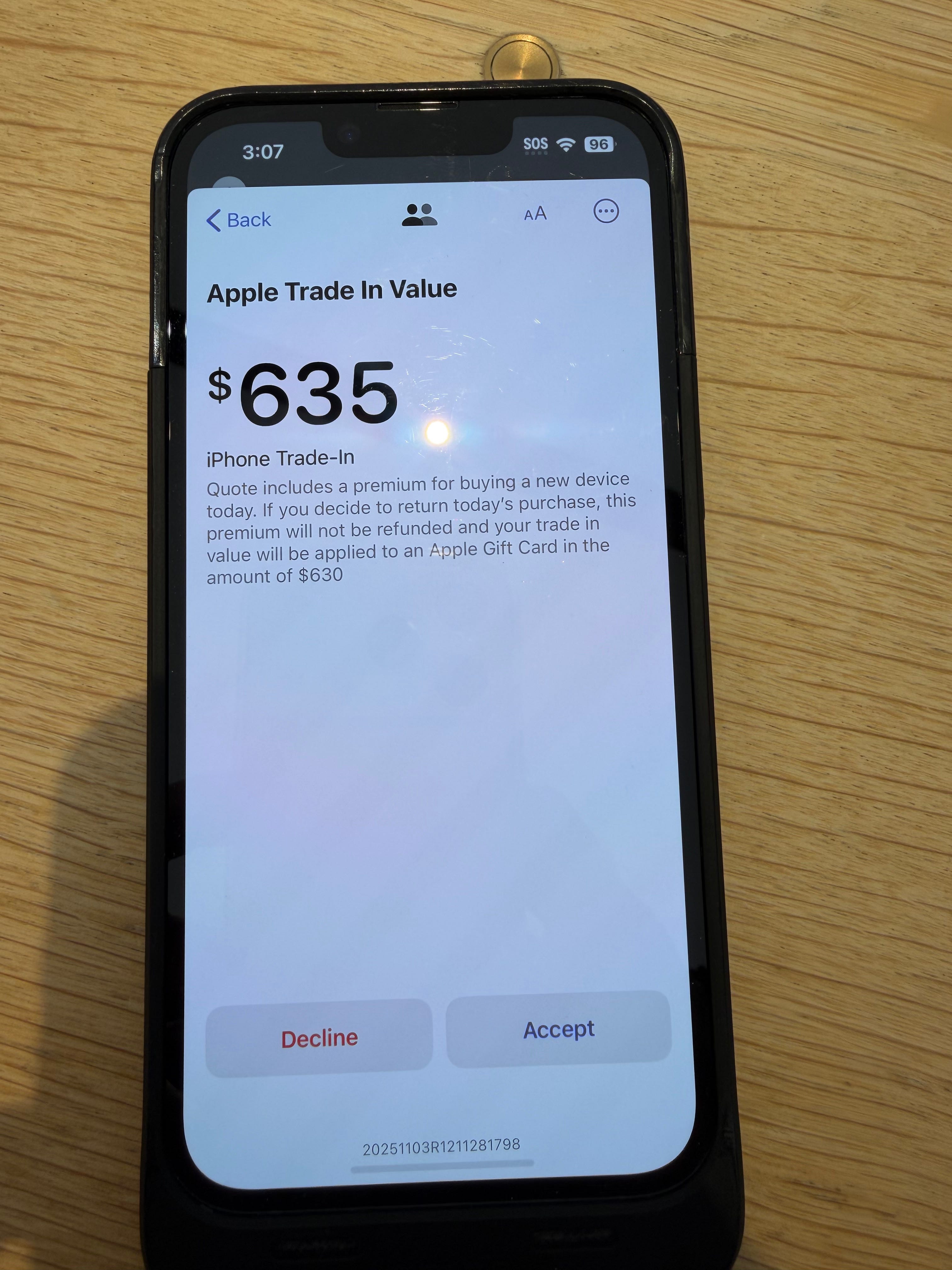
I didn’t get a “trade in value” of $635, per se.
Apple bought my phone for $635. Does that mean the company gave me $561.95 for the hardware and recouped the $73.05 of embedded HST on the transaction ($561.95 + $73.05 = $635), or did they just treat the two events as distinct transactions? Sold me one iPhone 17 and bought the old one in the hopes of re-selling it at a profit in, say, Morocco?
These are not the same transactions from a financial standpoint, of course, and the issue isn’t new in any event. The Toronto law firm of Landy Marr Kats LLP filed a Class Action suit against Apple in 2023 on the topic; Mckenzie Lake is also around the hoop. According to the Claim:
Under section 153(4) of the Excise Tax Act, a supplier providing full or partial consideration to a recipient trading-in “used tangible personal property” must only collect Sales Tax on the net value of the transaction, that being the value of the new taxable supply, minus the value of the used tangible personal property that is being traded-in.
Earlier this year, Lex Group filed a similar action in the Province of Quebec. Should we sign up?
If the Class Action suit is successful, is Apple on the hook for our overpayments, or would it be the governments that ultimately received the inflated tax revenue (assuming Apple isn’t pocketing the difference)?
MRM
(note: I own Apple shares)