
Kent State, redux
The end of Gen Z's innocence

Dear Kiddos,
The assassination of Charlie Kirk earlier this week will go down as your generation’s “Kent State” moment. The context is undoubtedly different, but I think that Mr. Kirk’s murder has many of the hallmarks of the 1970 shooting of 13 college young students on the campus of Kent State University.
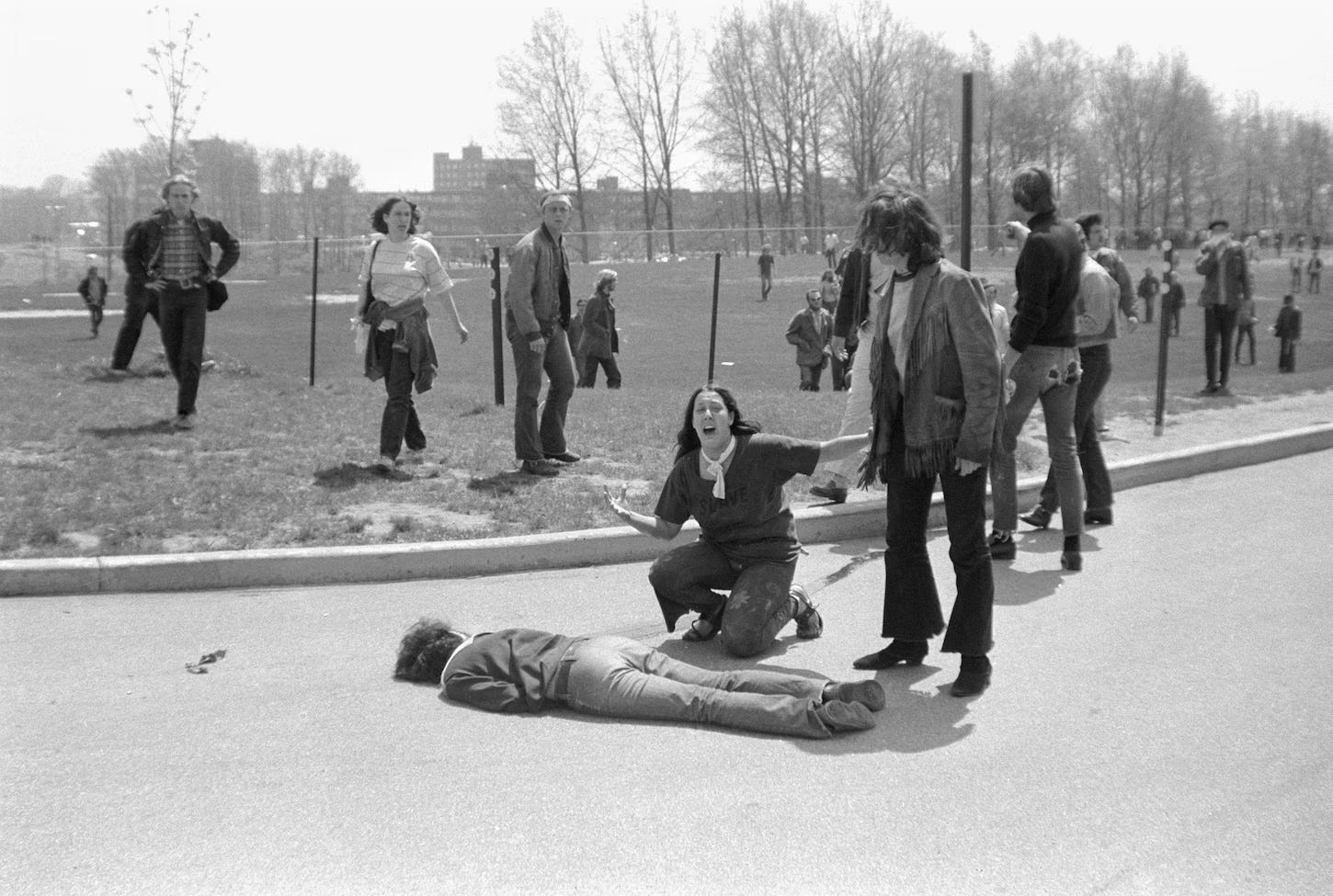
The short story is that “the shootings took place…during a rally opposing the expanding involvement of the Vietnam War into Cambodia by United States military forces, as well as protesting the National Guard presence on campus and the draft. Twenty-eight National Guard soldiers fired about 67 rounds over 13 seconds.” Two of students who died were part of a group of >300 that were formally part of the anti-war rally, while the other pair were bystanders who happened to be watching the proceedings between classes.
This is John Filo's Pulitzer Prize–winning photograph. He captured the scene shortly after one of the students was fatally shot by a National Guardsman:
Equally famous is the Neill Young (“Uncle Neil” to our friends at Pearl Jam) song “Ohio.”
The parallel is that every modern generation of American students seems to experience a gut-wrenching flashpoint. The 19 and 20 year-olds who were killed that day in Ohio were facing off against other young Americans, much like Mr. Kirk. Although not every protestor was a local college student, the Kent State crowd was definitely standing up for what they believed in.
Just as Mr. Kirk was.
Over 58,000 American troops died in Vietnam over the course of that war, and about 30% of those fatalities were individuals who’d been drafted by the U.S. government to join the military. Many Americans were opposed to the entire exercise, so you can appreciate why they might be marching in the streets. That’s where the parallel with Mr. Kirk’s death gets a bit tenuous.
There are already countless “bad takes” on Mr. Kirk’s death, and it seems foolhardy to choose any one example. But, I think it’s useful to understand just how much animosity there appears to have been. Not to explain-away his murder but to prove why it’ll wind-up being be so consequential in your memory banks when you’re my age.
This post was written by a Montreal-based journalist named Taylor C. Noakes:
Charlie Kirk died as he lived: propagating hateful myths about marginalized groups in our society.
Literally.
He was shot seconds after falsely insinuating that transgender people are more prone to committing mass shootings.
Kirk became rich and famous spreading hateful lies, trafficking in conspiracy theories (some of which were antisemitic) and railing against the LGBTQ community. Ironically, he argued that school shootings were a small price to pay for the Second Amendment.
He was not simply a right-wing pundit with whom one might disagree in polite conversation. He was both a profiteer and architect of America’s increasingly violent culture war.
This isn’t a “both sides” event — political violence in America is almost exclusively the realm of the political right. Put another way, there is no left-wing equivalent to Charlie Kirk — that’s how extreme he was. Trump will likely use his death to further the destruction of U.S. democracy.
There’s no excuse for political violence — but Charlie Kirk is absolutely responsible for making political violence more likely in America.
He never “lowered the temperature” as so many politicians and pundits are now disingenuously pleading; he spent his entire adult life pouring fuel on the fire.
You reap what you sow.
Mr. Noakes is not some random crackpot I found on the internet. The federal government has subsidized his Cult MTL outlet with our tax dollars for years. He regularly writes for both The Globe and Mail and Toronto Star. At least he used to.
Mr. Kirk was a devout Christian, and I have to assume that Mr. Noakes thought his headline was hilarious: “To Hell With Charlie Kirk.”
While thousands of Americans were drafted to fight in Vietnam, often against their will, no one was forced to attend a rally and hear Mr. Kirk say things they didn’t like. University administrators didn’t hire Mr. Kirk as a lecturer at a required course.
That didn’t seem to matter to either the person who assassinated him nor those who danced when they saw him mortally wounded. They hated some combination of what he stood for, his success as an organizer for President Donald Trump’s 2024 election campaign, his wealth, and his ability to publicly destroy many of the intellectual canards that manifest themselves within your generation.
They all wanted him dead.
Had Mr. Kirk followed a different life path, he’d be alive today. His two small children wouldn’t now grow up fatherless.
Does that mean that Mr. Kirk made reckless choices? That, by publicly advocating for a type of nation he believed in, he made himself a target? That the best way to protect yourself from dangerous people is to keep a low profile? Is that the message this tragic event sends to your generation?
Keep your thoughts to yourself for fear that they might inflame others?
Consider this: on January 15, 1916, your Great-Great Uncle Andrew went down to the recruiting centre in Collingwood, Ontario to volunteer for the Canadian Over-Seas Expeditionary Force. The Great War had been underway for about 18 months at that point, and although he was only 17 years of age at the time, he clearly wanted to make a difference in the world. As he wasn’t yet 18, Uncle Andrew wasn’t even eligible to join the military, so they back-dated his date of birth. This wasn’t some rash decision, either — he passed his physical in November 1915, six weeks prior to enrolling, according to his formal military record.
Uncle Andrew didn’t wield a microphone, like Mr. Kirk.
He was assigned to the Canadian Machine Gun Corp and spent five crucial months posted to France in 1918. 238,000 Canadians and Newfoundlanders were killed or wounded during WWI, of the 650,000 who served between 1914-18. Uncle Andrew didn’t likely know that an incredible ~37% of those who signed-up would eventually become a casualty statistic, but there’s no doubt that he and his family knew there was a chance that he wouldn’t return alive.
Despite being younger than you are today, he went anyway. Just as millions of others did over the last two centuries; most of your friends will have similar stories from their family trees.
There will always be people who would do you harm, whatever decade you might be born in. People like Uncle Andrew wanted to preserve a rules-based society, and they put their young lives on the line to ensure that freedom-loving countries like Canada might flourish. But for folks like him, there’s no us — not as you know “us” to be, anyway.
In this era, there will be individuals who hate your way of life. Who might get angry about your views on a subject they feel very passionate about. Who might want to kill civilians, as was the case on Sept 11th, simply due to their nationality. Or their religion, as you witnessed on Oct. 7th.
The day before he was shot, I wrote about preserving our country’s values. Mr. Kirk’s murder speaks volumes about what might be at stake — and how fractious things have become in our society.
Mr. Kirk was recently asked how he wanted to be remembered. His response seems genuine: “I want to be remembered for courage, for my faith.” Mr. Kirk died defending a set of values that were important to him, just as so many have done in both war and peacetime — for centuries.
A life worth living takes some courage, and it feels unavoidable at this moment.
Love Daddy
(this post, like all blogs, is an Opinion Piece reflecting a personal view)
The only similarities between Kent State and Charlie Kirk's killing is, they both happened on college campuses. Period.
Perceptive piece as always, Mark
Whatever happened to the wise Roman proverb "De mortuis nil nisi bonum"?