
Canada's bridge to Nowhere?
Whatever happens, the Gordie Howe bridge project taught us at least one useful lesson

News report: U.S. President Donald Trump threatens to block opening of Gordie Howe International Bridge
If Canada wanted to build a ~$6.5 billion bridge to Nowhere, we might have chosen a more picturesque destination than Delray, Michigan, as much as every Canadian should pay a visit to SlowsBBQ in nearby Corktown before they die. I’m advised that the OG “Bridge to Nowhere” is a 1936 concrete arch structure in California’s San Gabriel Mountains that was built for a road project that wound up being abandoned in 1938 when floods made it clear that Mother Nature would have none of it.
Canadians are getting used to our own never-ending stream of disasters, albeit of the political kind.
Speaking of “Slow(s),” whether or not the Gordie Howe International Bridge (GHIB) opens in 2026 or 2029, the reality is that 10,000 Ontario-based Exporters have been waiting for this particular infrastructure project since it was first hinted at by then-Prime Minister Jean Chretien and then-President George W. Bush almost 25 years ago. I suppose Canadian entrepreneurs can wait a bit longer at this point, but U.S. businessfolk do elect members of the House and Senate in 34 U.S. States that count Canada as their best customer. Their businesses will equally benefit from the anticipated shorter commercial truck wait-times at GHIB, so perhaps cooler Presidential heads will ultimately prevail.
One need not even mention the huge strides in the GHIB’s contraband screening technologies that are going to crimp the plans of all of the narco-trucking companies that thought they could overwhelm the new site via sheer brute force.
My faint recollection is the Michigan owns half of the project as it is, so President Trump already has his win. More importantly, the reason why Canada put up all of the capital to build an international bridge, including the U.S. Customs Plaza and associated Michigan highway upgrades, was simple: neither President Barack Obama nor President Trump (#45) added the U.S. side of the project to any of their annual infrastructure budgets. Despite the fact that the first Trump Administration referred to the project as a “priority” in 2017, for example (see prior post “Gordie Howe International Bridge passes first Trump test” Jan. 27-17).
The one thing we did need from them — a Presidential Permit — was issued (and never revoked) in time to begin the serious spending phase under the purview of Ottawa’s Windsor-Detroit Bridge Authority.
In terms of revenue, 100% of the tolls, after paying the annual P3 availability payment, are destined to go to the Canadian Treasury until such time as we’ve recouped the capital we put up to build the thing. At that point, as memory serves, we split the profits 50/50 with our Michigan partners.
Seems like American taxpayers negotiated a great deal, all things considered.
This project has already died a thousand deaths, such as the time in 2010 when the Michigan State Senate refused to pass a bill that would have allowed construction to proceed. It took a few more years, but thanks to then-Governor Rick Snyder (MI-R), and business groups such as the Detroit Regional Chamber, everyone found a way to get the project to the launch pad; despite the Moroun Family filing 36 (or was it 39?) different lawsuits as they sought to protect their juicy Ambassador Bridge business.
Understandably, as I told them myself.
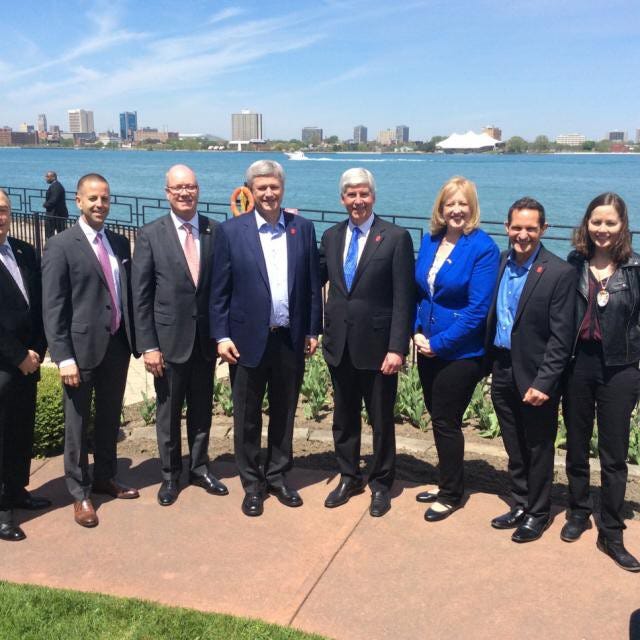
(GHIB naming ceremony photo credit: PMO handout?)
If you’re wondering why the bridge isn’t open already, no one should be blaming Mr. Trump. That’s largely former WDBA Chairman Dwight Duncan’s fault (see representative prior post “Pressure on Gordie Howe bridge project may be paying off” Oct. 26-16). This January 2026 report from The Windsor Star tries to outline what was standing in the way of the blessed opening, even if it was the same list of items as six months ago:
After delays in what is a large and complex project, including during a global pandemic, construction was expected to be finished in 2025 with an opening in Fall 2025. The predicted opening has changed to “early 2026,” according to the WDBA: “The exact opening date will depend on our ongoing quality reviews, testing and commissioning.” That includes training and staffing for the many different operations (from customs and tolling to traffic control and road maintenance).
The reality is even worse, which brings us to the lesson for Canada as it looks to tackle a series of new large, complicated infrastructure projects.
When Prime Minister Stephen Harper and Transport Minister Lisa Raitt announced their initial WDBA management team and Board of Directors in 2014 (I was Chairman), our instructions were simple: “Get ‘er done.”
It had to be done safely, of course. And each decision would have to show value for money. Community benefits were never far from the minds of some, and an Environmental Assessment had called for snake protection fences during construction. On and on the list went.
There were still thousands of decisions left to make, but the Aboriginal consultations had been concluded, and we had a supporter in the Michigan Governor’s office (even now). After more than a decade on the drawing board, and with Mr. Moroun flailing in Court, there was no time to waste.
The project was a Public-Private-Partnership (P3), which meant that we’d hand over a site, along with a series of plans and assumptions (soil quality, traffic, interest rates, etc.) to a collection of private sector bidding groups. They’d come back with a proposal and a timeline, paired with a price to formalize the design, build the bridge, and operate/maintain it for the next few decades. Government and WDBA officials would collaborate with the private sector at every step of the way, but, ultimately, you’re in industry’s hands.
“All” we had to do was stimulate the bids, push Ottawa on a daily basis, protect the annual budget allocation from Finance, manage PR, work with the Michigan Governor’s office, and not screw up.
In one of our earliest meetings, our new WDBA CEO, Mike Cautillo, described that the first key step in building this particular bridge — post-award of the P3 contract — was to prepare the ground for what would eventually become the Canadian Customs plaza site. Apparently, the soil wasn’t sturdy enough to handle the aggregate weight of the buildings, cars and transport trucks that would be expected to occupy this particular parcel of land.
The “fill and settlement” matter would take a full two years to settle, and there was nothing anyone could do about that. The nature of the ground may have called for extruded polystyrene blocks, but it matters not to the story. Whoever won the P3 project bid would need to undertake this crucial work before anything else could happen on the Canadian side of the Detroit River.
There wasn’t even much for them to do regarding the construction of the parkway that would ultimately connect Highway 401 to the Canadian plaza, which was already nearing completion.
It was August or September 2014 at this point, and the PM wanted the bridge open in 2020, which meant that two years was a considerable chunk of our available clock. It was going to take at least a year to analyze the various bids and negotiate the eventual P3 contract, implying that the “Fill and Settlement” element of the project — literally Phase One — would be unlikely to begin before Q1 2016. With two years of “filling and settling” to follow, the winning P3 construction team would be left to tinker away on the U.S. side of the border while time slowly passed.
Do the math: as construction on the Canadian side couldn’t begin until Q1 2018, a 2020 opening was in doubt if we didn’t do something.
The idea just came to us: pull the Canadian customs plaza site prep out of the P3 contract. The WDBA would start on that now, knowing that whomever won the ultimate prize would gladly utilize the work. No matter how fast the bidding and negotiating phase went, the “fill and settlement” would be almost complete once we formally handed over the site to the winning construction team two year’s hence.
Of course, I was told “no, it’s part of the project contract.” But it didn’t have to be, just as the Herb Gray parkway was a separate piece of the puzzle. It would have been impossible to get it all done in time if we waited, making the push worth the effort.
The next bureaucratic objection was that the winning bidder wouldn’t necessarily accept that the quality of the “fill and settlement” contractor’s work was up to snuff. That was easy, too: “BS! We’ll hire the same folks that they’d hire, and the same arms-length geotechnical engineering firm will provide the appropriate sign-off.”
The final one was meant to be the killer punch: “We don’t have the money, and it’s not in the Corporate Plan.” The Ottawa bureaucrats didn’t think we knew that Parliament had already allocated $600 million/annum for GHIB spending in the last federal budget, and the Corporate Plan is a thing that Treasury Board had dreamt-up to keep the Crown Corporations in line.
All we wanted to do was spend ~$80 million of that massive envelope on something that was a pre-requisite to actually starting the bridge. Ottawa’s reaction? They wanted to reprofile the $600M to the next fiscal year, as Finance didn’t think we’d be able to meet the PM’s timeline.
Well, we were sure gonna try.
The argument ended when I suggested to the Associate DM that if everyone in Ottawa wanted to reprofile the funding, which Windsor-West NDP MP Brian Masse would be sure to notice when the next turn of the Estimates was published, the Clerk of the Privy Council was going to have to alert the PM that the bridge was already going to be late — mere weeks after he’d announced 2020 as the opening date.
As you can imagine, no one wanted to make THAT particular call.
We issued the tender for the Canadian Port of Entry Plaza construction process in 2014, and dust began to fly in 2015 with contractor AMICO. When new Liberal Infrastructure and Communities Minister Amarjeet Sohi showed up in December 2015 for a site tour, that was why he was able to be photographed pulling on the levers of a front-end loader.
No one had won the larger bridge contract as at that point; in fact, Ottawa was still sitting on the RFP (see representative prior post “On the launch pad: The Gordie Howe International Bridge” Dec. 16-15).
Something that simple saved the project 18-24 months in the process, all for an $80 million spend that was going to happen anyway (representing barely 1% of the cost of the project). If the bridge opens soon, remember this story.
In the event you find yourself responsible for one of these projects down the road, and there seem to be plenty to go around right now, my advice is:
make sure you know exactly what your PM, Premier or Minister want done
act like you’re spending your own money
only join a Board and/or management team that share a common vision about i) the task at hand and ii) how to deliver
common sense will solve most problems
don’t take “no” as an answer from people who’s comp / career aren’t impacted by your ability to execute #1
you’ll do worse than operating on a business timeline, no matter what others are doing
If you’ve got mediocre folks on the team, call in reinforcements
keep the public and media up-to-date on what you’re doing, why, and the problems you encounter
there’s a reason why you were chosen: fulfill it
“The sooner you start, the sooner you’ll finish.”
MRM
(note: this post, like all blogs, is an Opinion Piece)
Good essay! It’s sad that a U.S president has to wake up Canadians to one of the great Canadian infrastructure projects in recent times. This bridge should be open now. 🇨🇦 🇺🇸 🌉
Mark, this is the most comprehensive and pragmatic account of the facts I have recently read. Now, instead of political posturing and inflated rhetoric, it is time to emphasize the 3 major benefits:
1. The amount of revenues to be pocketed by Canada and the USA over the next 40 years, in a 50/50 revenue split
2. The immediately enhanced border security, which should be welcomed on both sides of the border
3. A significant number of new law enforcement jobs to be created in Canada and the USA, in addition to the military-grade reconnaissance technology that could be purchased in the USA over the lifespan of this project
And as Hillel the Elder so eloquently said thousands of years ago: “The rest is… commentary.”